
How to Install Power BI Desktop

I'll show you how to set up and install Power BI on your Windows personal computer in this little blog post. Sadly, macOS and Linux distributions are not supported by Microsoft Power BI Desktop. I've seen that not everyone finds it simple and easy to install the Power BI desktop. Therefore, by sharing this, I hope to encourage you to download Power BI for your computer and begin your data analytics journey.

Power BI Desktop

Option #1: Download via Windows Store (recommended) 

1. To install the Power BI desktop can be done using Go to Microsoft Store-> Search Power BI Desktop 


2. Then select the Power BI Desktop App
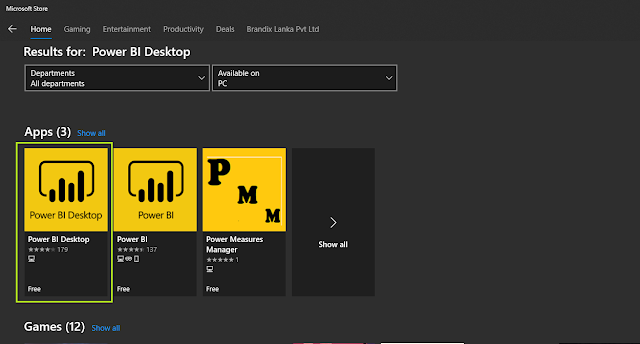

3. Click the Get button to install the Power BI Desktop app on your PC


4. It will take a few seconds or minutes depending on the network bandwidth. However, you can see the progress during the download and installation time. Once it is completed, you can see there is a Launch button appearing to Launch the application. 


Option #2: Download via the Internet 

Sometimes there might be problems with accessing the Windows store. Those who have challenges downloading via the Windows store can go to the direct download option. 

1. Go To download the Power BI URL: https://powerbi.microsoft.com/en-us/downloads/. In the Microsoft Power BI Desktop area, you will find two options. Download and Advanced Download options. Click the Advanced Download option. 

2. It will bring you to the Download page. Click the Download button. 

3. You need to select the setup file to download based on your system. If it is a 64 Bit computer, select PBIDesktopSetup_x64.exe as I do. Chose otherwise, if your machine is 32-bit.  Click Next


4. Then save the setup in the Downloads location to install it once the download is completed. 


You can see the progress of downloading and installing it. 


Comments

Popular posts from this blog

Run T-SQL Script Files Using Command Line

Most of the time when we need to execute a SQL script or statement, then we go for SQL Server Management Studio to execute our T-SQL scripts. But the same result we can achieve using Command Prompt. This is very simple way to do that just a matter of write a command and pass few arguments. You can see the process status like as in when you execute a query in Management studio. Use-case : There may be having some situations you won't be able to execute T-SQL script using Management Studio. Most of the time when doing data population. In my case, I had a situation I needed to populate a Database without using backup/restore. Once I generated script with all the schemas and related data it took around 400+Mb sql file.  SQL Server Management Studio will not allow you to run the script unless you execute the query in high-end box. Because, when the file loaded to the memory it will too hard to cater our requirement. You may probably get  memory ...

How to Create a Date Table in Few Steps Using Power BI

Calendar Dimension or Calendar Table is one of the crucial table in a Power BI model. I never have seen any data warehouse data model which does not have a Calendar table so far in my development. Because, when it comes to data warehousing or dimension modeling you may storing various business processes or events as Facts. So those events anyway occur in particular date or time. So simply there wouldn’t be a Power BI data model without a date table. In this post, I’m going to share with you how to create a date table within few steps. Actually, there are two DAX measures which we can use to create a date table. Calendar(DAX) and CalendarAuto(Auto). Calendar(DAX) = You can pass start date and End date as parameters you need to create date table. CalendarAuto(DAX) = You can use this function without passing any parameter. Then it will generate the dates based on your data model dates.  You can simply copy the below DAX code and paste in your Power BI Desktop DAX e...

Forecast Financial Data Using MS Excel 2016

With the New release of Excel 2016  Microsoft has provided handy way to do the forecasting using the user data. Within few clicks you will be able to do the forecasting without knowing the thorough knowledge about the Data Mining or Predictive Analytics. Just to have some domain knowledge about the data you are going to play around will be enough. From this blog post I will be showing a sample data forecast analysis I've done using MS Excel 2016 Forecast Feature. 1. Created a Test Data Set for do the prediction. I used vTimeSeries   view in AdventureWorksDW2014 sample database. (This view returns the Time Series  data Sales data which change over the time. This can be useful to do the Financial forecast on sales data) 2. In this view return the sales amount correspond to the reporting date. I've made a small change to the query in-order to improve the readability. I sort the data-set using reporting date. 3. Open Microsoft Excel 2016 and Create a N...